
How long will a generator run? Runtime and fuel math
Runtime figures on a spec sheet are measured at a single load, usually a light one. Here is how to translate them into the hours and gallons you will really need during an outage.
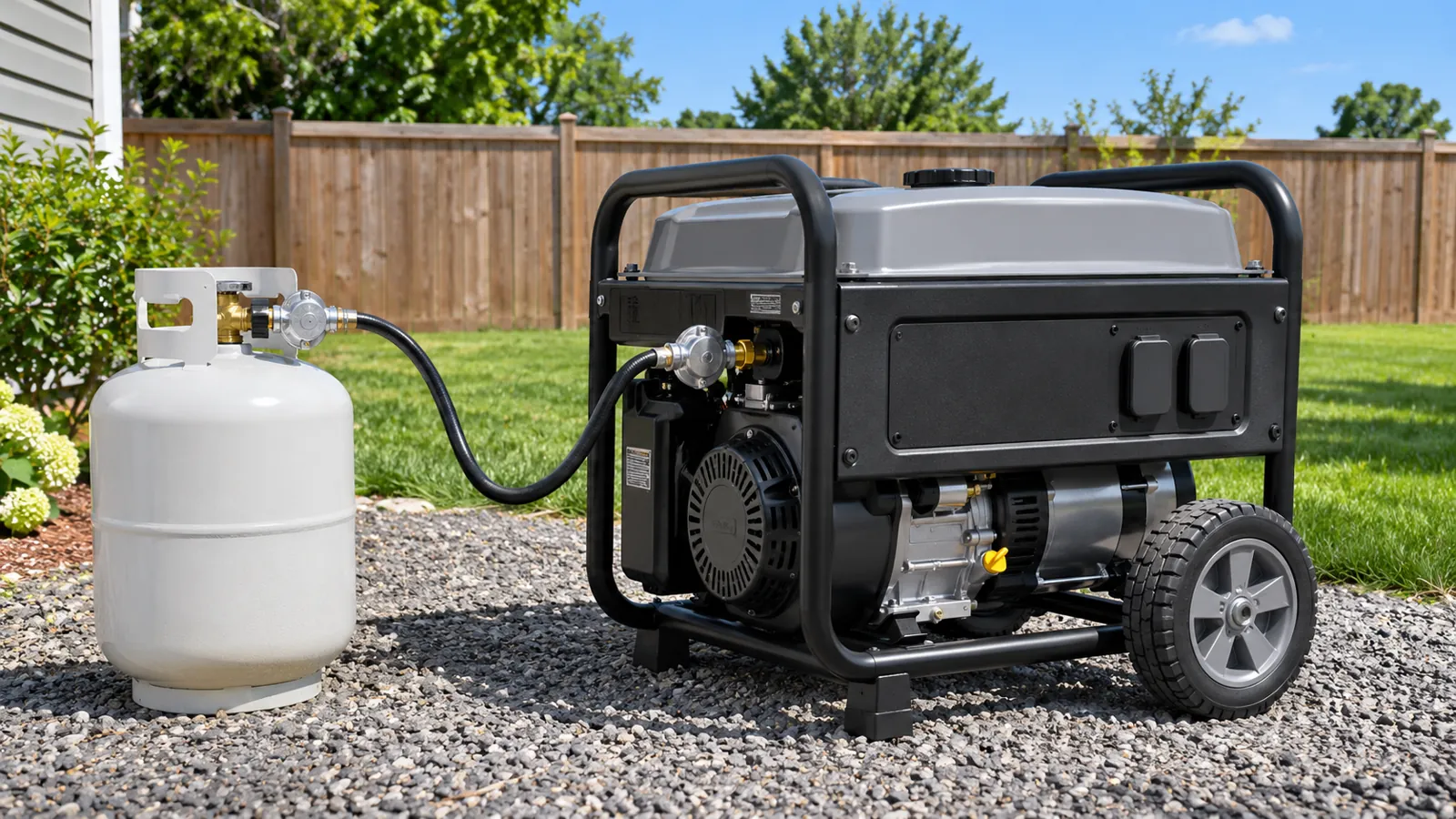
Runtime depends on load
Manufacturers usually quote runtime at 25% or 50% load. Fuel consumption rises with load, but not in a straight line: an engine burns a base amount of fuel just to keep running, and inverters in eco mode slow down further at light load.
As a rule of thumb, compared with the quarter-load figure:
| Load | Runtime vs. the quarter-load figure |
|---|---|
| 25% | 100% (the published number) |
| 50% | about 60-70% |
| 75% | about 45-55% |
| 100% | about 35-45% |
So a generator rated 12 hours at quarter load may give about 8 hours at half load and 4 to 5 hours at full load.
Gallons per hour by size
Typical gasoline consumption, from manufacturer data:
| Generator | Typical tank | Gallons per hour, 25% load | Gallons per hour, 50% load |
|---|---|---|---|
| 2,000 W inverter | 1-1.2 gal | 0.1-0.15 | 0.2-0.25 |
| 3,500-4,500 W inverter | 2-3.5 gal | 0.2-0.3 | 0.3-0.45 |
| 3,500-4,500 W open frame | 3.5-4.5 gal | 0.3-0.4 | 0.4-0.55 |
| 7,500-9,500 W open frame | 6-8 gal | 0.5-0.6 | 0.7-0.9 |
| 12,000 W open frame | 8-10 gal | 0.7-0.8 | 1.0-1.3 |
The pattern is clear: a larger generator burns more fuel even at the same output, because its engine is bigger. That is why oversizing costs you fuel every hour. Use the sizing worksheet to stay close to your real need.
Our picks for this guide
The highest-rated models in our comparison for this topic.
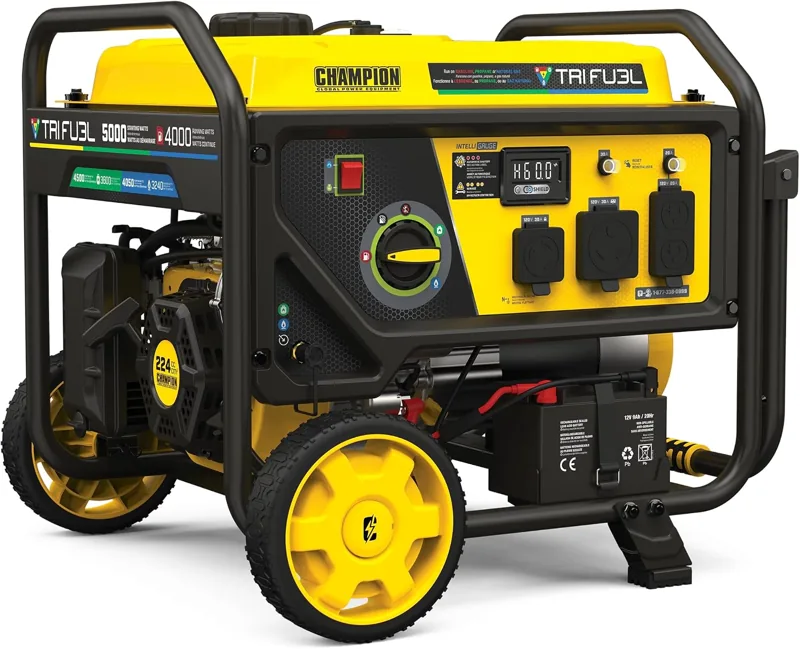 Champion 201223 4000-Watt Electric Start Tri Fuel Generator
7.2/10 · $500–$800
4,000 running W · Tri fuel
Tri fuel
Check price
Read the review →
As an Amazon Associate we earn from qualifying purchases, at no extra cost to you.
Propane: the 20 lb tank
A full 20 lb cylinder holds about 4.7 gallons of propane. Since propane carries roughly 20-25% less energy per gallon than gasoline, a generator burns more gallons of propane than of gasoline for the same job. Typical figures on one 20 lb tank:
- 2,000-3,000 W dual fuel inverter: 12-20 hours at quarter load.
- 3,500-4,500 W open frame: 8-12 hours at quarter load, 5-8 hours at half load.
- 7,500-9,500 W open frame: 5-8 hours at quarter load, 3-5 hours at half load.
A 100 lb cylinder holds about 23.6 gallons, five times as much. Details in gas vs. propane.
How much fuel for a three-day outage?
Work it out in three steps: estimate your average load, pick hours of operation, multiply.
Example 1: essentials with a 4,500 W open frame
- Fridge, freezer, sump pump, lights, router: average load around 1,500 W, about a third of rated output.
- Consumption: about 0.4 gal/h.
- Running 16 hours a day (off for a few hours at night, fridge and freezer stay cold): 0.4 x 16 = about 6.5 gallons per day.
- Three days: about 20 gallons, or four 5-gallon cans.
Example 2: well pump and furnace with a 9,500 W open frame
- Average load around 3,000 W.
- Consumption: about 0.6-0.7 gal/h.
- 18 hours a day: about 12 gallons per day.
- Three days: about 36 gallons, or seven to eight 5-gallon cans.
Example 3: a 2,000 W inverter for a fridge and electronics
- Average load around 500 W in eco mode: about 0.12 gal/h.
- 18 hours a day: about 2 gallons per day; three days: about 6 gallons.
You can stretch any of these by running the generator in blocks, for example 2 hours on, 2 hours off for the fridge and freezer, which keeps food safe while cutting fuel use.
Storing that much fuel
Gasoline goes stale in about 30 days without stabilizer, and local rules often limit how many gallons you may keep at home. Store it in approved, labeled cans, away from the house, in a cool, ventilated place, with stabilizer added at filling, and rotate it every few months. Propane stores indefinitely, which is a strong argument for dual fuel when you plan for long outages.
Extended-run options
- Extended-run fuel caps and external tank kits feed the generator from a larger gasoline container. Use only kits approved for your model, keep connections tight and the container outdoors with the generator.
- Larger propane cylinders (40 lb, 100 lb) or a connection to a home propane tank, installed by a qualified gas technician with the right regulator and hose.
- Natural gas on a tri-fuel model, connected by a licensed plumber or gas fitter.
Refueling safely
- Turn the generator off and let it cool for several minutes before refueling. Gasoline on a hot muffler can ignite.
- Refuel outdoors, in daylight if possible, away from flames, and never overfill.
- Keep the generator at least 20 feet from the house, exhaust pointed away, even during short runs; see the safety guide.
Runtime and tank size appear in every product card on our home backup and 7,500 W pages; the methodology explains how we weigh them.
Our pick for this guide
- Best portable generator for home backup (68 models)
- Best dual fuel generators (80 models)
- Best 7500 watt generator (19 models)
- Best inverter generators (120 models)
Frequently asked questions
How long will a generator run on a full tank?
It depends on the size and load. A 2,000 W inverter runs about 8 to 10 hours on roughly a gallon at quarter load; a 7,500 to 9,500 W open frame runs about 8 to 12 hours on a 6 to 8 gallon tank at quarter load, and roughly half that at full load.
How much gas do I need for a 3-day power outage?
For essentials on a mid-size generator, plan on roughly 15 to 25 gallons. A large unit running a well pump and furnace can need 30 to 40 gallons over three days.
Can I run a generator 24 hours a day?
Many can run continuously if you shut them down to refuel and check oil regularly, typically every 8 hours. Running in blocks saves fuel and gives the engine a break.