
How to choose a portable generator
Start from what you need to power, not from the biggest number on the box. This five-step method turns your list of appliances into a wattage, a fuel choice and a short list of features that actually matter.
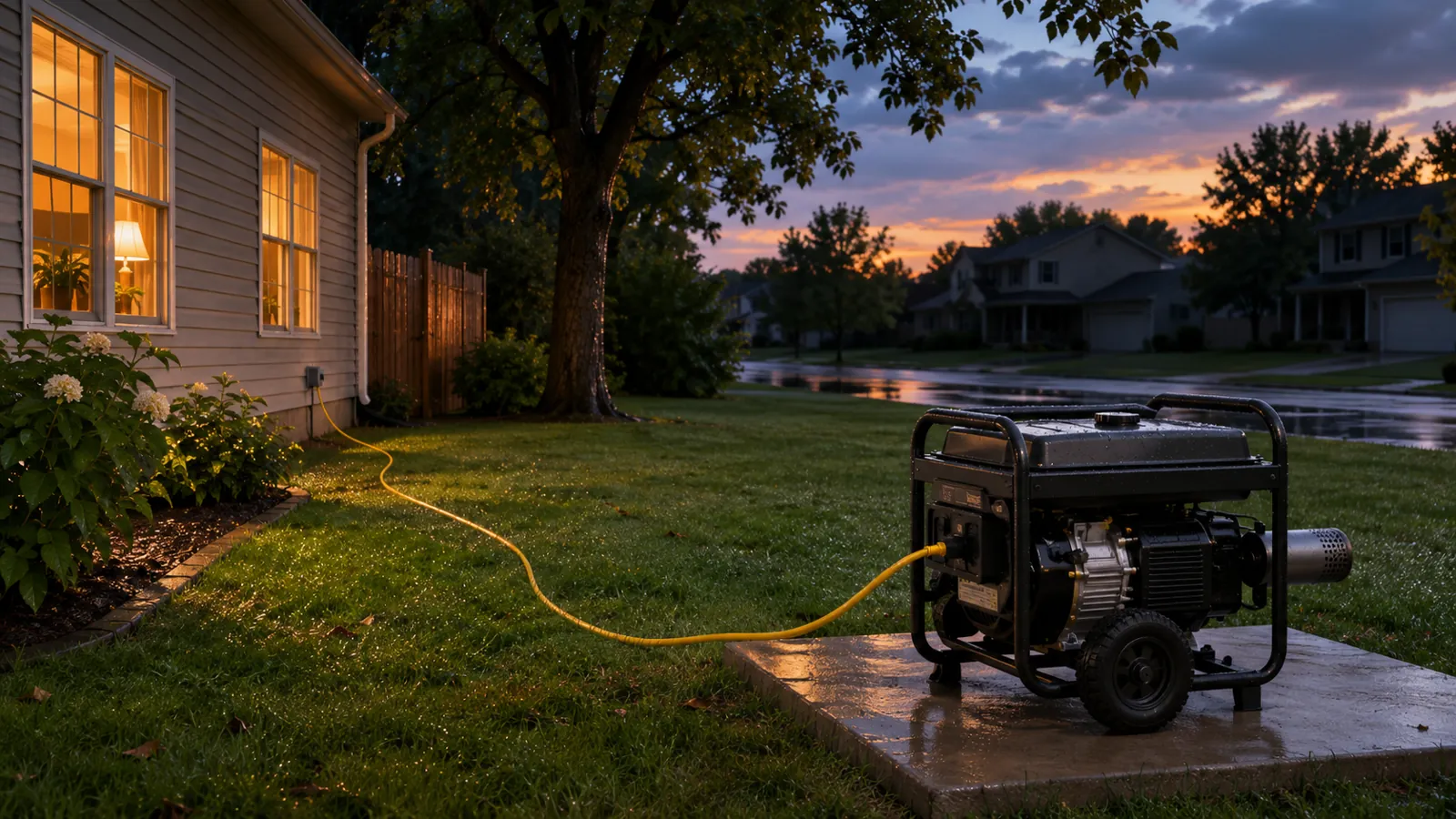
1. List the loads you want to run
Walk through the house (or the campsite) and write down every appliance you want on generator power during an outage or a trip, with two numbers for each: running watts and starting watts. The data plate, the manual or the manufacturer's site gives them; when only amps are listed, multiply by 120 for a 120 V appliance and by 240 for a 240 V one.
Split the list in two: what must run at the same time (fridge, freezer, sump pump, furnace blower, lights, router) and what can wait its turn (microwave, coffee maker, space heater, power tools). That split usually saves you a size class. The wattage worksheet has a table of typical US appliances.
2. Size the generator: running vs. starting watts
A generator has two ratings:
- Running (rated) watts: what it can deliver continuously. Your simultaneous load should stay at or below about 80% of this figure.
- Starting (surge, peak) watts: a short burst, a few seconds at most, to start motors and compressors. A fridge that runs at 700 W can ask for 2,000 W or more for a moment.
The method: add the running watts of everything that runs together, then add the extra starting watts of the single largest motor once, since motors rarely start at the exact same second. Typical results:
| Use | Running watts |
|---|---|
| Camping, electronics, a small fridge | 1,800-2,500 W |
| Outage essentials: fridge, freezer, sump pump, lights, router | 3,500-5,000 W |
| Essentials plus well pump, furnace or window AC | 6,000-8,000 W |
| Most of the house through a transfer switch | 9,000-12,000 W |
Size pages: 2,000 W, 3,500 W, 4,500 W, 7,500 W and 9,500 W.
Our picks for this guide
The highest-rated models in our comparison for this topic.
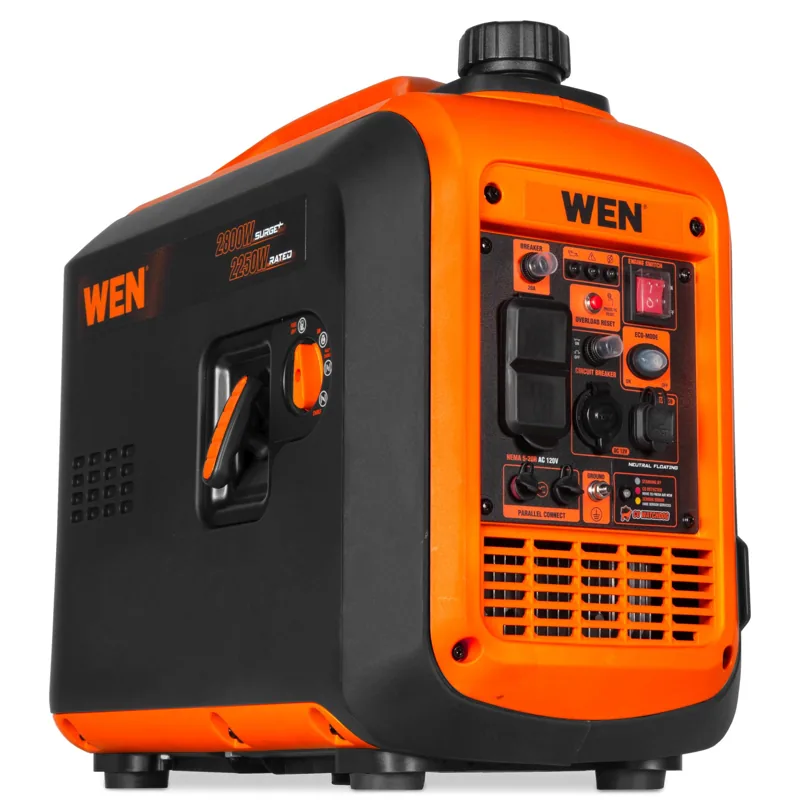 WEN 56280iX 2800W Inverter with CO Watchdog
7.1/10 · $300–$500
2,250 running W · Gas inverter
Easy to carry
Check price
Read the review →
As an Amazon Associate we earn from qualifying purchases, at no extra cost to you.
3. Choose the fuel
- Gasoline only: the simplest and usually the cheapest per watt, but gas goes stale in about 30 days without stabilizer and is hard to find after a big storm.
- Dual fuel (gas + propane): propane stores for years and burns cleaner, at the cost of roughly 10% less output. See gas vs. propane.
- Tri-fuel: adds a natural gas inlet, which needs a permanent connection by a licensed professional.
4. Inverter or open frame?
Inverter generators produce clean power (total harmonic distortion under 3%), throttle down with light loads, and run at roughly 48-60 dB(A). They are the default choice for camping, RVs and sensitive electronics, and most models from 1,800 to about 4,000 W fit the job. Open-frame (conventional) generators run at a fixed 3,600 rpm, are louder (around 68-76 dB(A)), but deliver far more watts per dollar, which makes them the usual pick for 7,500 W and up. The full comparison is in inverter vs. conventional.
5. Check the features that matter
- Outlets and transfer-switch readiness: for home backup, look for an L14-30R (30 A, 120/240 V) or a 14-50R (50 A) outlet so an electrician can connect the unit through a transfer switch or an interlock kit. A 120 V-only generator cannot run a 240 V well pump. See connecting a generator to your house.
- Noise: compare dB(A) at the same distance and load, usually 23 ft at quarter load. Details in the decibels guide.
- Start type: recoil only, electric start with a battery, or remote start from a key fob or app. Electric start matters if anyone in the household cannot pull a cord.
- CO shutoff: a sensor that stops the engine when carbon monoxide builds up around the unit. Many current models are built to the ANSI/PGMA G300 or UL 2201 safety standards. It is a backup, never a reason to run a generator closer to the house. Read the carbon monoxide safety guide before first use.
- CARB and EPA compliance: every generator sold in the US must meet EPA emission rules; California requires a CARB-compliant model. Check the listing if you live there.
- Weight and wheels: a 2,000 W inverter weighs about 40-50 lb; a 7,500 W open frame often tops 180 lb and needs a wheel kit.
- Warranty and parts: 2 to 3 years of residential coverage is common; a US parts and service network matters more than one extra year on paper.
Budget benchmarks
Under $500 buys a small inverter or a 3,500-4,500 W open frame. From $1,000 to $1,500 you reach large dual-fuel open frames with electric start, or mid-size inverters with CO shutoff. Our under $1,000 picks sort the best value by size.
Our approach
We compare published manufacturer specs, warranty terms and owner feedback; we do not run the units ourselves. The scoring is explained on the methodology page, and the comparison tool lines up models side by side.
Our pick for this guide
- Best portable generators of 2026: our ratings (174 models)
- Best portable generator for home backup (68 models)
- Best inverter generators (120 models)
- Best dual fuel generators (80 models)
Frequently asked questions
What size portable generator do I need for a house?
For outage essentials such as a fridge, freezer, sump pump, lights and a router, 3,500 to 5,000 running watts is usually enough. Add a well pump, furnace or window AC and you move to 6,000 to 8,000 running watts.
Is an inverter generator worth it?
Yes for camping, RVs and electronics: it is quieter, uses less fuel at light loads and produces clean power. For large home backup loads, an open-frame generator gives more watts for the money.
Do I need a transfer switch for a portable generator?
You need a transfer switch or a UL-listed interlock kit with a power inlet box, installed by a licensed electrician, to power house circuits. Without one, run appliances only through heavy-duty extension cords plugged into the generator.