
Quiet generators: decibel ratings explained
Generator noise ratings look precise, but a decibel figure only makes sense with its distance and load. This guide explains the scale and shows how to compare models fairly.
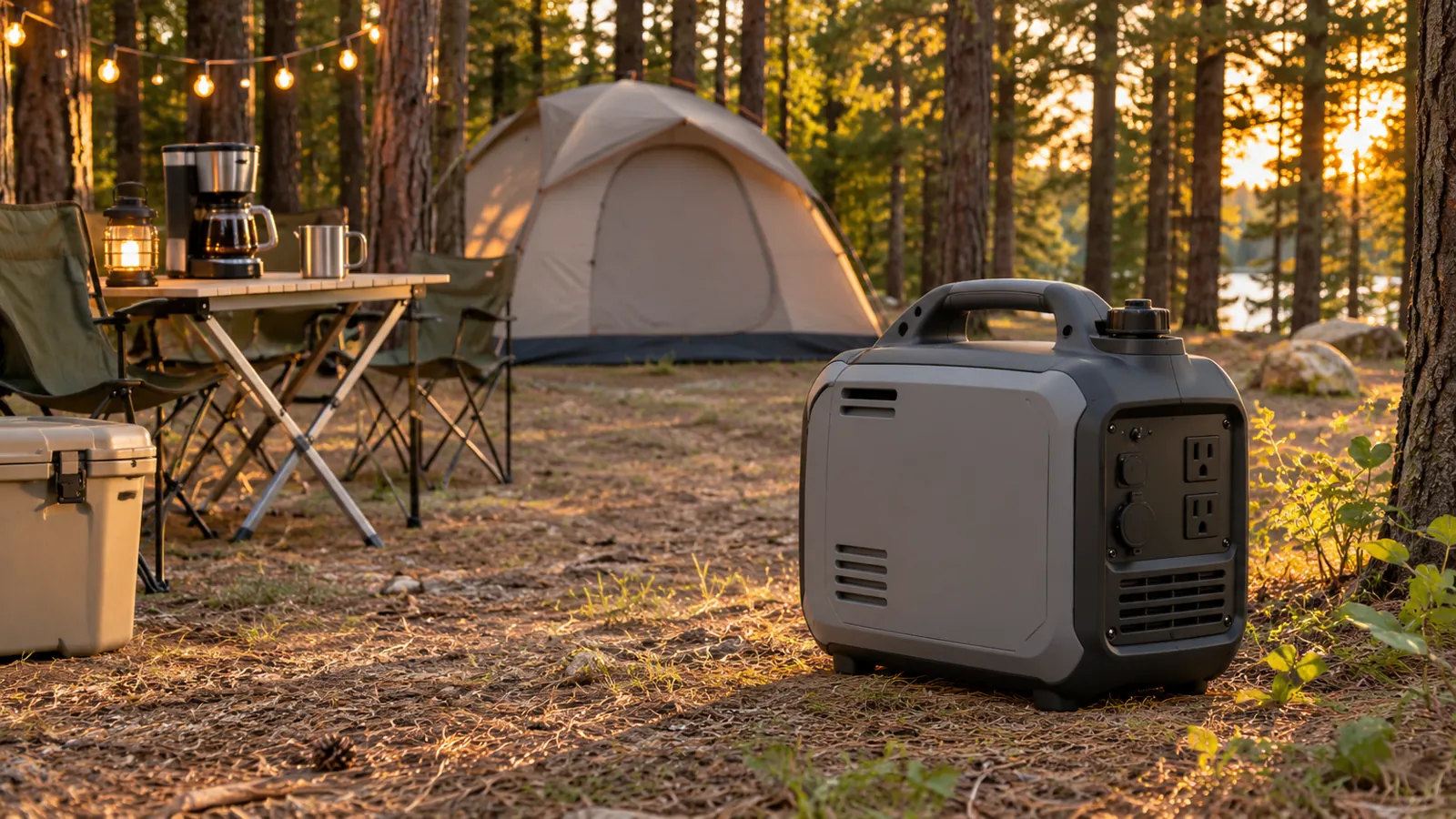
The decibel scale in plain terms
Sound is measured in decibels (dB). Generator specs use dB(A), a weighting that mirrors how the human ear hears, giving less importance to very low and very high frequencies. The scale is logarithmic:
- +3 dB means double the sound energy, a small but noticeable step.
- +10 dB is perceived as roughly twice as loud.
- +20 dB sounds about four times as loud.
So a 70 dB(A) open frame does not sound "a bit louder" than a 60 dB(A) inverter; it sounds about twice as loud, and four times as loud as a 50 dB(A) unit.
| Sound | Approximate level |
|---|---|
| Quiet library, light rain | 40 dB(A) |
| Normal conversation at 3 ft | 55-60 dB(A) |
| Busy restaurant | 65-70 dB(A) |
| Vacuum cleaner at 3 ft | 70-75 dB(A) |
| Gas lawn mower at operator position | 85-95 dB(A) |
How generator noise is measured
Most manufacturers measure at 7 meters (23 ft), and most quote the figure at 25% load ("quarter load"), sometimes in eco mode. At half load or full load, the same generator can be 5 to 10 dB(A) louder, because the engine speeds up.
When you compare two models, check that both figures use the same distance and the same load. A 52 dB(A) "at 23 ft, quarter load" rating and a 52 dB(A) "at 23 ft, no load" rating are not equivalent. Some brands publish a range, such as 52-58 dB(A), from light to rated load; that is the most useful form.
Our picks for this guide
The highest-rated models in our comparison for this topic.
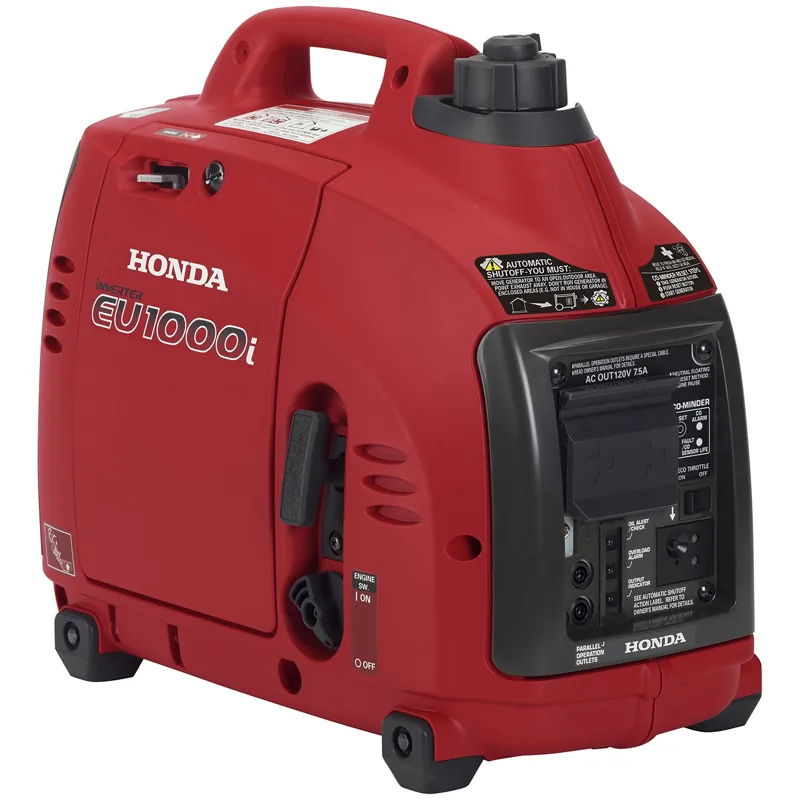 Honda EU1000i (EU1000T1AN)
5.3/10 · $800–$1,200
900 running W · Gas inverter
Whisper quiet
Check price
Read the review →
As an Amazon Associate we earn from qualifying purchases, at no extra cost to you.
Typical values
| Generator type | Typical noise at 23 ft, quarter load |
|---|---|
| Small inverter, 1,800-2,500 W | 48-58 dB(A) |
| Mid-size inverter, 3,000-4,500 W | 52-62 dB(A) |
| Large inverter, 6,000-9,000 W | 58-66 dB(A) |
| Open frame, 3,500-5,000 W | 66-72 dB(A) |
| Open frame, 7,500-12,000 W | 70-76 dB(A) |
Inverters are quieter for three reasons: the engine slows down at light load, the enclosed shell absorbs sound, and the muffler is designed for low noise. See inverter vs. conventional.
Campground and park rules
- National Parks: federal rules cap generator noise at 60 dB(A) measured at 50 feet, and parks set generator hours, often a morning, midday and evening window. Some campgrounds ban generators entirely.
- State parks and private campgrounds: many set quiet hours, commonly 10 p.m. to 6 or 7 a.m., during which generators must be off.
- HOAs and municipalities: some limit residential noise at the property line, often around 55-65 dB(A) at night. Outages may be exempt, but check before running a large open frame all night.
Since distance cuts noise (see below), a 58 dB(A) at 23 ft inverter lands around 52 dB(A) at 50 ft in open air, which fits the National Park rule; a 72 dB(A) open frame does not. See the camping picks and the RV picks.
How to make a generator quieter
- Add distance: in open air, each doubling of distance cuts about 6 dB. Moving a generator from 25 ft to 50 ft takes off about 6 dB(A); to 100 ft, about 12 dB(A). Use a longer, heavier-gauge cord to compensate for voltage drop.
- Point the exhaust and engine side away from you and your neighbors.
- Use eco mode on an inverter whenever the load allows.
- Use solid barriers at a distance: a fence, a wall of the shed or a dedicated sound baffle (a deflector panel) placed between the generator and the listeners, with the generator still fully in the open air.
- Put it on soft ground or a rubber mat rather than a hard deck or concrete pad that amplifies vibration.
- Run a smaller unit: two small inverters in parallel let you run just one at night.
Never enclose a generator in a box, a shed or a closed "quiet box" that blocks airflow. It overheats the engine and concentrates carbon monoxide. Any baffle must leave the generator open on all sides and keep it at least 20 feet from the house, exhaust away from doors, windows and vents. Read the safety guide.
What to look for when buying
- A published dB(A) figure with distance and load stated.
- A range from quarter load to rated load when available.
- An eco or throttle mode on inverters.
- A realistic size: a generator working at 30% of its capacity is quieter than one at 90%.
The quietest models in each class are in the quiet generator picks, and the comparison tool shows noise side by side.
Our pick for this guide
- Best quiet generator (46 models)
- Best inverter generators (120 models)
- Best generator for camping (61 models)
- Best generator for RV (84 models)
Frequently asked questions
How quiet is 52 dB(A) for a generator?
About as loud as a quiet conversation at a few feet, measured at 23 feet from the generator. In practice, a 52 dB(A) inverter is barely noticeable from a neighboring campsite.
At what load are generator decibels measured?
Most manufacturers measure at 23 feet and quarter load, often in eco mode. At half or full load the same unit can be 5 to 10 dB(A) louder, so compare figures taken under the same conditions.
Can I build a box to make my generator quieter?
Not a closed box. Enclosing a generator blocks cooling airflow and traps carbon monoxide. Use distance, exhaust orientation and an open sound baffle placed between the generator and the listeners instead.