
Portable generator vs. power station: which fits your needs?
A portable generator burns fuel to make power on demand; a power station stores power in a battery. Both are often sold side by side, but they solve different problems.
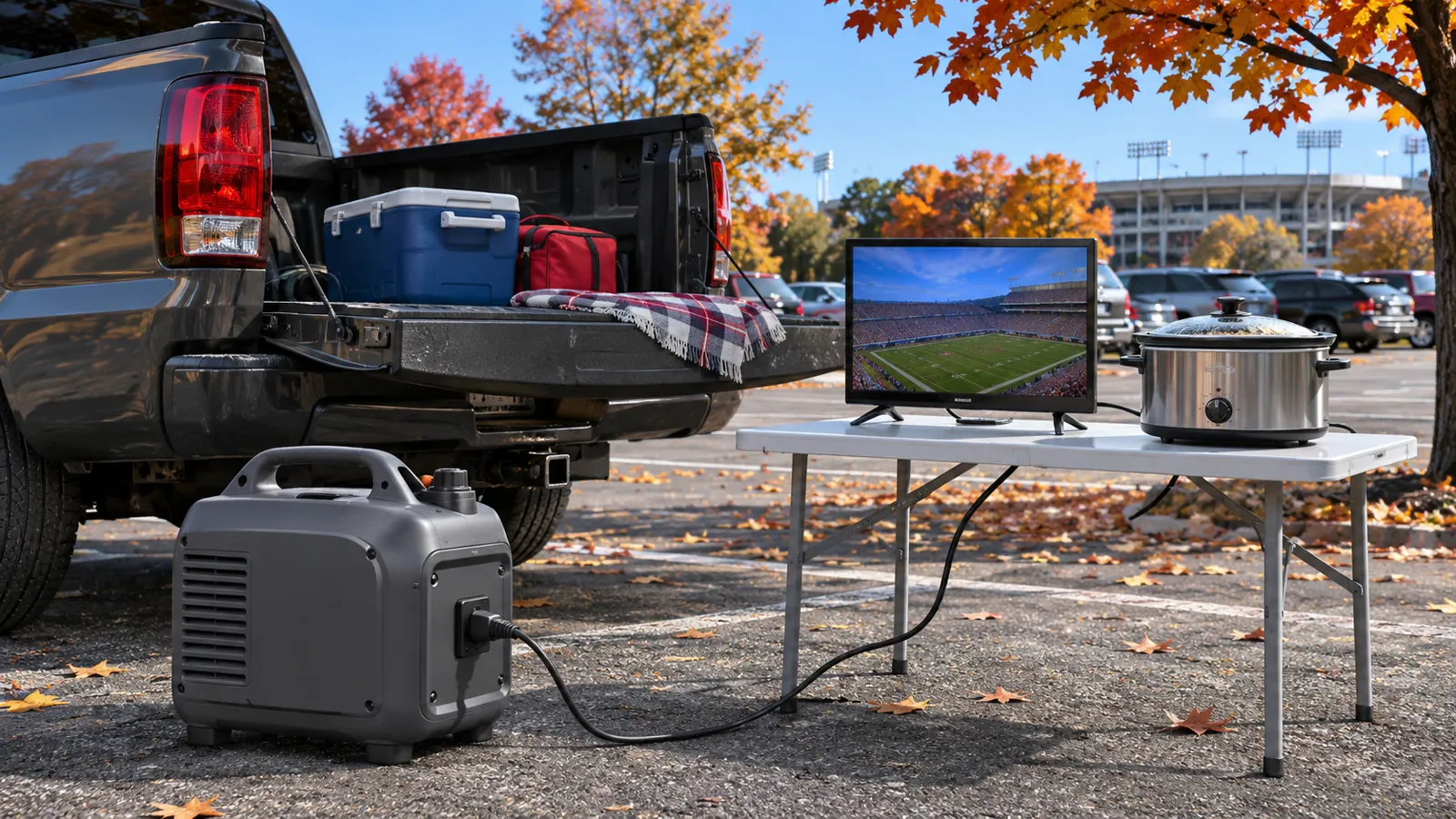
Two different machines
A portable generator is a small engine driving an alternator. As long as you feed it gasoline or propane, it makes electricity, from about 2,000 W for an inverter up to 12,000 W or more for a large open frame.
A portable power station is a lithium battery (usually LiFePO4) with a built-in inverter, charged from a wall outlet, solar panels or a car. It delivers its stored energy silently, then needs recharging. Capacities run from a few hundred watt-hours to 4,000 Wh and more with expansion batteries.
Side-by-side comparison
| Portable generator | Power station | |
|---|---|---|
| Energy source | gasoline, propane, natural gas | stored battery energy |
| Typical output | 2,000-12,000 W | 300-3,600 W |
| Runtime | as long as you refuel | limited by battery capacity |
| Noise | 48-76 dB(A) at 23 ft | nearly silent (cooling fan) |
| Indoor use | never | yes |
| Emissions | carbon monoxide | none at the point of use |
| Maintenance | oil, filters, spark plug, fuel | almost none |
| Weight per usable kWh | low once you count fuel | high |
| 240 V output | common on 5,000 W and up | rare, mostly large units |
Power and runtime: where generators win
The core advantage of a generator is sustained high output. A 7,500 W open frame runs a 240 V well pump, a furnace blower, a fridge and a freezer at the same time, hour after hour, as long as you have fuel. A 2,000 Wh power station running a 700 W fridge plus a few lights would be empty in about 2 to 3 hours of continuous draw (fridges cycle, so real life is longer, but not days).
For multi-day outages, well pumps, central heating blowers, sump pumps under heavy rain or job-site tools, a generator is the practical tool. Use the sizing worksheet to find the right class.
Our picks for this guide
The highest-rated models in our comparison for this topic.
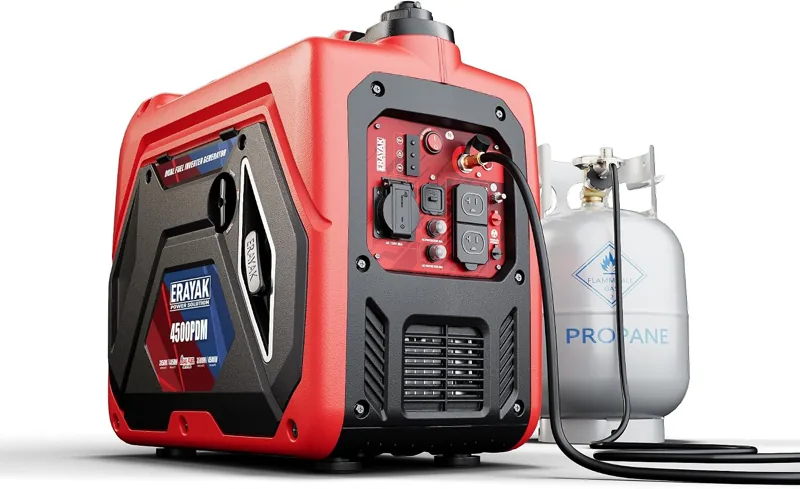 ERAYAK 4500PDM Dual Fuel Inverter
7.6/10 · $500–$800
3,500 running W · Dual fuel inverter
Dual fuel inverter
Check price
Read the review →
As an Amazon Associate we earn from qualifying purchases, at no extra cost to you.
Safety and indoor use: where power stations win
A generator must always run outdoors, at least 20 feet from the house, with the exhaust pointed away from doors, windows and vents, and the home needs battery-powered CO alarms. It cannot sit in a bedroom next to a CPAP or in an apartment with no yard. A power station can. That single difference makes a battery the only option for apartment dwellers and for powering medical devices at the bedside. See the carbon monoxide guide.
Noise
Even the quietest inverter generators run at about 48-52 dB(A) at 23 ft at quarter load, and open frames reach 68-76 dB(A). A power station is silent except for a cooling fan. For campgrounds with quiet hours or a night of CPAP use, the battery wins easily; see the decibels guide.
Cost
Per watt of output, generators are far cheaper: under $500 buys either a 2,000 W inverter generator or a 4,000-4,500 W open frame, while a power station that can deliver 2,000 W continuously often costs $1,000 to $2,000. Per hour of use, the picture depends on how you charge the battery: solar is free once installed, gasoline is a recurring expense.
Long-term costs also differ. A generator needs regular oil changes, fresh fuel and occasional carburetor cleaning. A LiFePO4 power station typically needs almost nothing, though the battery slowly loses capacity over thousands of cycles.
Maintenance and readiness
A generator stored for a year with untreated gasoline may not start when the storm hits. Power stations simply need a top-up charge every few months. If you want a generator that starts on the first pull, follow the maintenance and storage checklist or choose a dual fuel model so you can store propane instead of gas.
Hybrid setups: the best of both
Many households combine the two:
- Day and night split: run the generator outdoors during the day to power the fridge, freezer and well pump while recharging a power station; at night, shut the generator off and let the power station run the CPAP, router and a few lights quietly.
- Fuel savings: a small inverter recharging a battery at a steady load runs more efficiently than a big generator idling all night for a 100 W load.
- Safety buffer: when the generator is off for refueling, the power station keeps essential devices running.
The generator stays outdoors at the usual distance; only the power station comes inside. Check the power station's AC charging input (often 1,000-1,800 W) against what the generator can supply.
Which one should you buy?
| Situation | Better choice |
|---|---|
| Multi-day outages, well pump, furnace, 240 V loads | Portable generator |
| Apartment, condo or no safe outdoor spot | Power station |
| CPAP and electronics overnight | Power station, or both |
| Camping with quiet hours, short trips | Power station or a quiet inverter |
| RV with roof AC | Inverter generator (or two in parallel) |
| Job site with saws and compressors | Open-frame generator |
Generator picks by use: home backup, camping and inverters.
Our pick for this guide
- Best portable generators of 2026: our ratings (174 models)
- Best inverter generators (120 models)
- Best generator for camping (61 models)
- Best portable generator for home backup (68 models)
Frequently asked questions
Can a power station replace a generator?
For short outages, electronics, a CPAP or camping, yes. For multi-day outages or large loads such as a well pump, furnace or several appliances at once, a generator remains far more practical.
Can I use a portable generator indoors if I open a window?
No, never. Carbon monoxide builds up even with windows open. Run a generator outdoors only, at least 20 feet from the house, and use a power station if you need power indoors.
Can I charge a power station with a generator?
Yes, that is a common hybrid setup. Run the generator outdoors at a safe distance and plug the power station's AC charger into it, then bring the charged station inside.