
How to connect a generator to your house
Running a few appliances on extension cords works, but powering a furnace, a well pump or hardwired circuits requires a proper connection. Here is how the safe options work and what to ask your electrician.
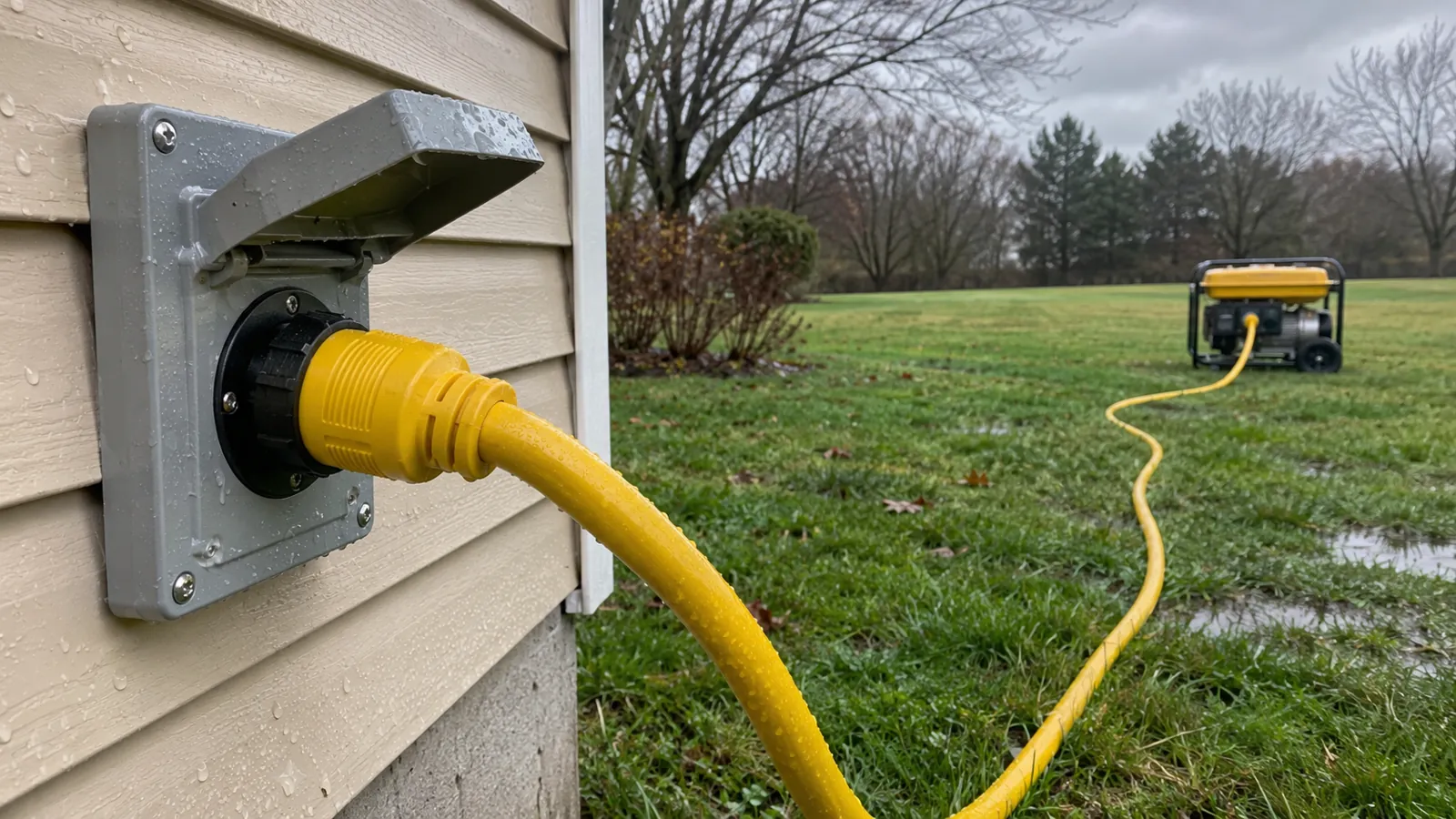
The rule: never backfeed
Plugging a generator into a wall outlet or dryer receptacle with a double-male cord is illegal in most places and deadly. It pushes power back into the utility lines, where it can electrocute line workers, and it can start a fire or destroy the generator when grid power returns. Every safe method below has one thing in common: the house is physically disconnected from the utility before generator power reaches the circuits. See the full safety guide.
Option 1: manual transfer switch
A manual transfer switch is a small subpanel next to your main panel, prewired to a selection of circuits (often 6 to 10). Each circuit has a switch: LINE for utility power, GEN for generator power. The generator plugs into a power inlet box outside the house through a cord.
- Pros: impossible to backfeed, lets you pick circuits one by one, often includes wattmeters.
- Cons: only the prewired circuits are covered.
Option 2: interlock kit + power inlet box
An interlock kit is a sliding plate on the main panel that makes it mechanically impossible to turn on the generator breaker while the main breaker is on. A dedicated, back-fed generator breaker connects to a power inlet box on the outside wall.
- Pros: any circuit in the panel can run on the generator, usually the lowest-cost option.
- Cons: you manage the load by turning breakers off and on; the kit must be UL-listed for your specific panel model.
Our picks for this guide
The highest-rated models in our comparison for this topic.
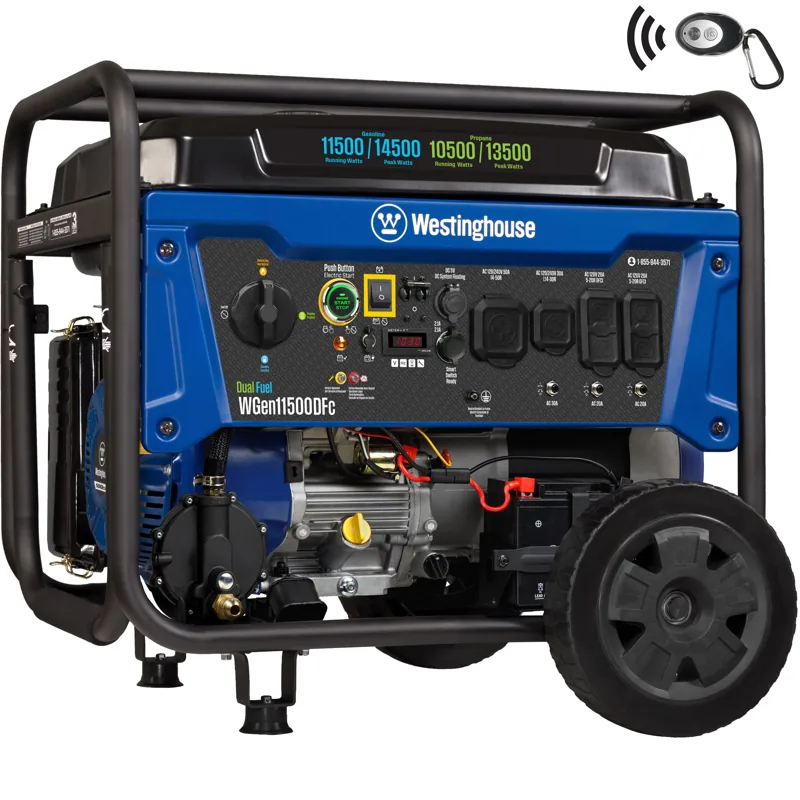 Westinghouse WGen11500DFc
8.3/10 · $1,200–$1,800
11,500 running W · Dual fuel
Top pick
Check price
Read the review →
As an Amazon Associate we earn from qualifying purchases, at no extra cost to you.
Option 3: automatic transfer switch for portables
Some automatic transfer switches work with portable generators that have remote or electric start: when the grid fails, the switch signals the generator to start and transfers the load. The generator still has to sit outdoors, at least 20 feet from the house, wired permanently or plugged in ahead of time. See the remote start picks.
All three options must be installed by a licensed electrician, with a permit and inspection where local code requires them.
Matching the outlet to the inlet
| Outlet on the generator | Rating | Max power | Typical use |
|---|---|---|---|
| L5-30R (twist-lock) | 30 A, 120 V | 3,600 W | 120 V-only transfer switch, some RVs with adapter |
| TT-30R | 30 A, 120 V | 3,600 W | RVs with a 30 A hookup |
| L14-30R (twist-lock) | 30 A, 120/240 V | 7,200 W | most home transfer switches and inlet boxes |
| 14-50R | 50 A, 120/240 V | 12,000 W | large generators, 50 A inlets, 50 A RVs |
The L14-30R is the common home backup connector: two 120 V legs, so it can power 240 V appliances such as a well pump. A 14-50R carries up to 12,000 W, but it only makes sense with a generator big enough to use it; see the whole-house portable picks. A 120 V-only generator cannot power 240 V loads, whatever the adapter.
Cord gauge and length
Use a cord made for generators, with matching connectors at both ends:
- 30 A (L14-30): 10-gauge, 4-conductor (10/4).
- 50 A (14-50): 6-gauge, 4-conductor (or 6/3 with an 8-gauge ground).
Keep the cord as short as the 20-foot clearance allows; 20 to 30 feet is typical. Longer runs need heavier wire to limit voltage drop. Never use a cord with damaged insulation or a missing ground pin.
Neutral bonding: bonded vs. floating
In a home electrical system, neutral and ground are bonded at one point only, the main service panel. Portable generators come either with a bonded neutral (neutral tied to the frame, needed when used standalone with cords) or a floating neutral (not tied to the frame).
Most interlock kits and many manual transfer switches do not switch the neutral, so the house panel already provides the bond. Connecting a generator with a bonded neutral can then create a second bond point, which may trip the generator's GFCI outlets and may not meet code. The right answer depends on the generator, the transfer equipment and local rules. Check the generator manual and let your electrician decide; do not modify the generator's wiring yourself.
Permits and inspection
Most US jurisdictions require an electrical permit for a transfer switch or interlock installation, and some utilities ask to be notified. The inspection protects you and confirms the installation cannot backfeed. Plan this before storm season.
How to switch over during an outage
- Place the generator outdoors, at least 20 feet from the house, exhaust pointed away.
- Connect the cord to the generator and the inlet box, then start the generator with no load.
- Turn the main breaker off (or set the switches to GEN), then turn on the generator breaker.
- Turn on circuits one at a time, largest motor first, staying within about 80% of running watts.
- When the grid returns, reverse the steps before shutting the generator down.
Generators with the right outlets are listed in the home backup picks, and the sizing worksheet tells you which circuits to include.
Our pick for this guide
- Best portable generator for home backup (68 models)
- Best portable generator for a whole house (37 models)
- Best 7500 watt generator (19 models)
- Best generator with remote start (52 models)
Frequently asked questions
Is an interlock kit as safe as a transfer switch?
Yes, when it is UL-listed for your panel and installed by a licensed electrician. It mechanically prevents the main breaker and the generator breaker from being on at the same time.
What outlet do I need on a generator to connect it to a house?
Most home inlet boxes use an L14-30 connector (30 A, 120/240 V, up to 7,200 W). Larger setups use a 14-50 connector rated 50 A, up to 12,000 W.
Do I need a permit to install a generator transfer switch?
In most US jurisdictions, yes. Your electrician will usually pull the permit and schedule the inspection.