
Inverter vs. conventional generator: which one to buy?
Inverter and conventional generators both burn fuel to make 120 V power, but they build it differently. That difference decides noise, fuel use, weight and what you can safely plug in.
How each one makes electricity
A conventional (open-frame) generator spins its alternator at a fixed 3,600 rpm, because that speed produces 60 Hz alternating current directly. Whether you power a phone charger or a well pump, the engine runs flat out.
An inverter generator produces high-frequency AC, converts it to DC, then rebuilds a clean 60 Hz sine wave with electronics. Because the output frequency no longer depends on engine speed, the engine can slow down when the load is light.
Power quality: THD and sensitive electronics
Total harmonic distortion (THD) measures how far the waveform strays from a pure sine wave. Utility power is typically under 5%.
- Inverter generators: usually under 3% THD, often closer to 1-2%.
- Conventional generators: often 5-25%; some recent models with better voltage regulation advertise under 5-6%.
Laptops, TVs, gaming consoles, variable-speed furnace blowers, modern refrigerators with control boards and medical devices such as CPAP machines all prefer clean power. A high-THD source can cause buzzing, overheating of power supplies or nuisance shutdowns. With an open frame, check the published THD figure before plugging in electronics.
Our picks for this guide
The highest-rated models in our comparison for this topic.
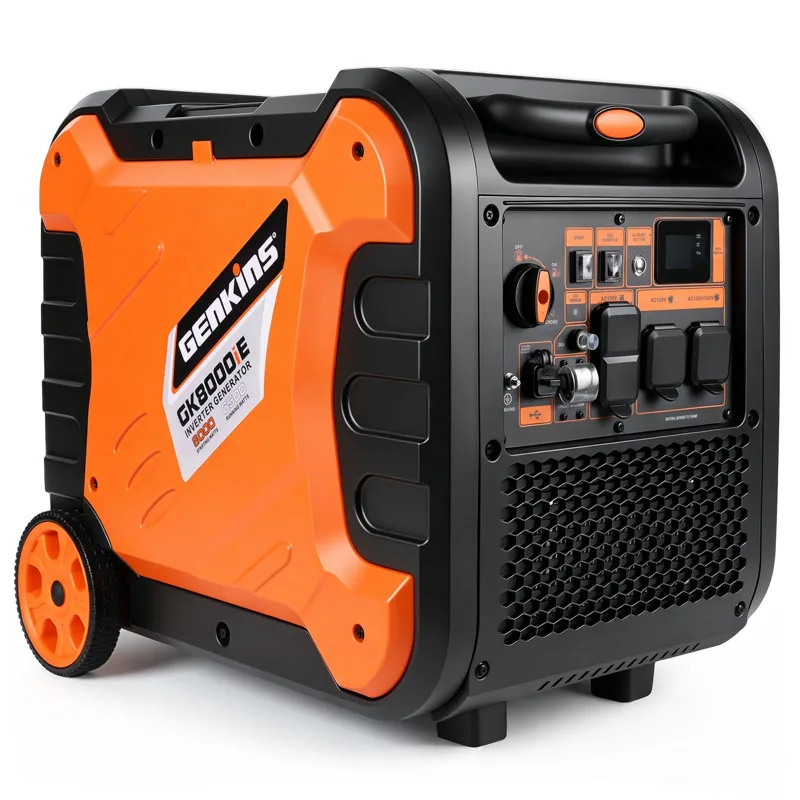 Genkins GK8000iE 8000W Inverter
8.2/10 · $500–$800
6,500 running W · Gas inverter
CO shutoff
Check price
Read the review →
As an Amazon Associate we earn from qualifying purchases, at no extra cost to you.
Fuel economy: eco or throttle mode
Inverters have an eco mode (also called economy or smart throttle) that idles the engine down to match the load. At quarter load, an inverter commonly uses 30-40% less fuel than an open frame of similar size, which also stretches runtime: many 2,000 W inverters run 8-10 hours on about 1 gallon at quarter load. Under heavy load the gap narrows, since both engines work hard. Eco mode can be slow to respond to a sudden big motor start; switch it off when you expect a large surge.
Noise
| Type | Typical noise at 23 ft, quarter load |
|---|---|
| Inverter, 1,800-2,500 W | 48-58 dB(A) |
| Inverter, 3,000-4,500 W | 52-62 dB(A) |
| Open frame, 3,500-5,000 W | 66-72 dB(A) |
| Open frame, 7,500-12,000 W | 70-76 dB(A) |
Every 10 dB sounds roughly twice as loud, so a 58 dB(A) inverter is perceived as less than half the volume of a 70 dB(A) open frame. The enclosed shell, the muffler design and the variable speed all contribute. More in the decibels guide.
Weight and size
A 2,000 W inverter weighs around 40-50 lb and fits in a car trunk; a 3,500-4,500 W inverter is typically 90-120 lb with wheels. A 7,500 W open frame often weighs 180-200 lb, more with electric start and a battery. See the lightweight picks.
Price per watt
This is where the open frame wins. Under $500 buys either a small inverter of about 2,000 W or an open frame of about 4,000-4,500 W. From $1,000 to $1,500 you can choose between a 4,000-5,000 W inverter and a 9,000-12,000 W dual-fuel open frame. Per running watt, a conventional generator often costs half as much.
When an open frame makes sense
- Whole-house or large home backup through a transfer switch, where you need 7,500 W and more plus a 240 V outlet for a well pump or several circuits.
- Job sites, where durability, high surge for compressors and saws, and low cost matter more than noise. See the construction picks.
- Occasional emergency use on a tight budget, when the generator sits 20 feet or more from the house anyway.
When an inverter is the better choice
- Camping, tailgating and campgrounds with quiet hours.
- RVs, especially with a parallel kit for a 30 A hookup.
- Running sensitive electronics, a CPAP or a home office.
- Long outages with light overnight loads, where eco mode saves fuel every hour.
Large inverters (6,500-9,000 W, some with 240 V) now blur the line, but they cost noticeably more than an open frame of the same output. For a mix of clean power and propane flexibility, see dual-fuel inverters.
The short answer
| Priority | Pick |
|---|---|
| Quiet, clean power, light weight, fuel economy | Inverter |
| Most watts for the money, 240 V home backup, job sites | Open frame |
| Both, with a bigger budget | Large inverter or two inverters in parallel |
Browse the inverter picks or the gasoline open-frame picks, and line up specs in the comparison tool.
Our pick for this guide
- Best inverter generators (120 models)
- Best gas generators (open frame) (24 models)
- Best quiet generator (46 models)
- Best dual fuel inverter generators (46 models)
Frequently asked questions
Is an inverter generator safe for electronics?
Yes. Inverter generators typically produce power with under 3% total harmonic distortion, which is as clean as or cleaner than utility power, so laptops, TVs and CPAP machines run normally.
Are conventional generators bad for electronics?
Not always, but many produce 5% to 25% harmonic distortion, which some electronics tolerate poorly. Check the published THD figure, or use a surge protector and keep sensitive devices on an inverter.
Why are inverter generators more expensive?
They add power electronics, a variable-speed engine and an enclosed, muffled shell. You pay more per watt in exchange for lower noise, better fuel economy at light load and cleaner power.