
Generator maintenance and storage: a complete checklist
Most generators that fail during a storm were never broken: they sat for months with stale fuel or a dead battery. A few minutes of maintenance each month prevents that.
The break-in period
A new engine sheds tiny metal particles as its parts seat. That is why manufacturers ask for an early first oil change, typically after the first 5 to 25 hours of use, depending on the model. Check your manual for the exact figure and for any break-in instructions (some recommend running at moderate, varying loads for the first few hours).
Most generators ship without oil. Fill to the mark with the oil type and viscosity specified in the manual, often SAE 10W-30 for general use, sometimes 5W-30 for cold weather. A low-oil shutdown sensor protects the engine but is not a substitute for checking the level.
Routine maintenance schedule
Intervals vary by model; your owner's manual always wins. Typical figures:
| Task | Typical interval |
|---|---|
| Check oil level | before each use, and every 8 hours of running |
| First oil change | after 5 to 25 hours (break-in) |
| Oil change | every 50 to 100 hours, or at least once a season |
| Clean air filter | every 50 hours, more often in dusty conditions |
| Replace air filter | when damaged or heavily soiled, often yearly |
| Inspect spark plug | every 100 hours or yearly |
| Replace spark plug | every 100 to 300 hours, or as listed |
| Clean spark arrestor | every 100 hours (required on many public lands) |
| Inspect fuel lines and fuel filter | yearly |
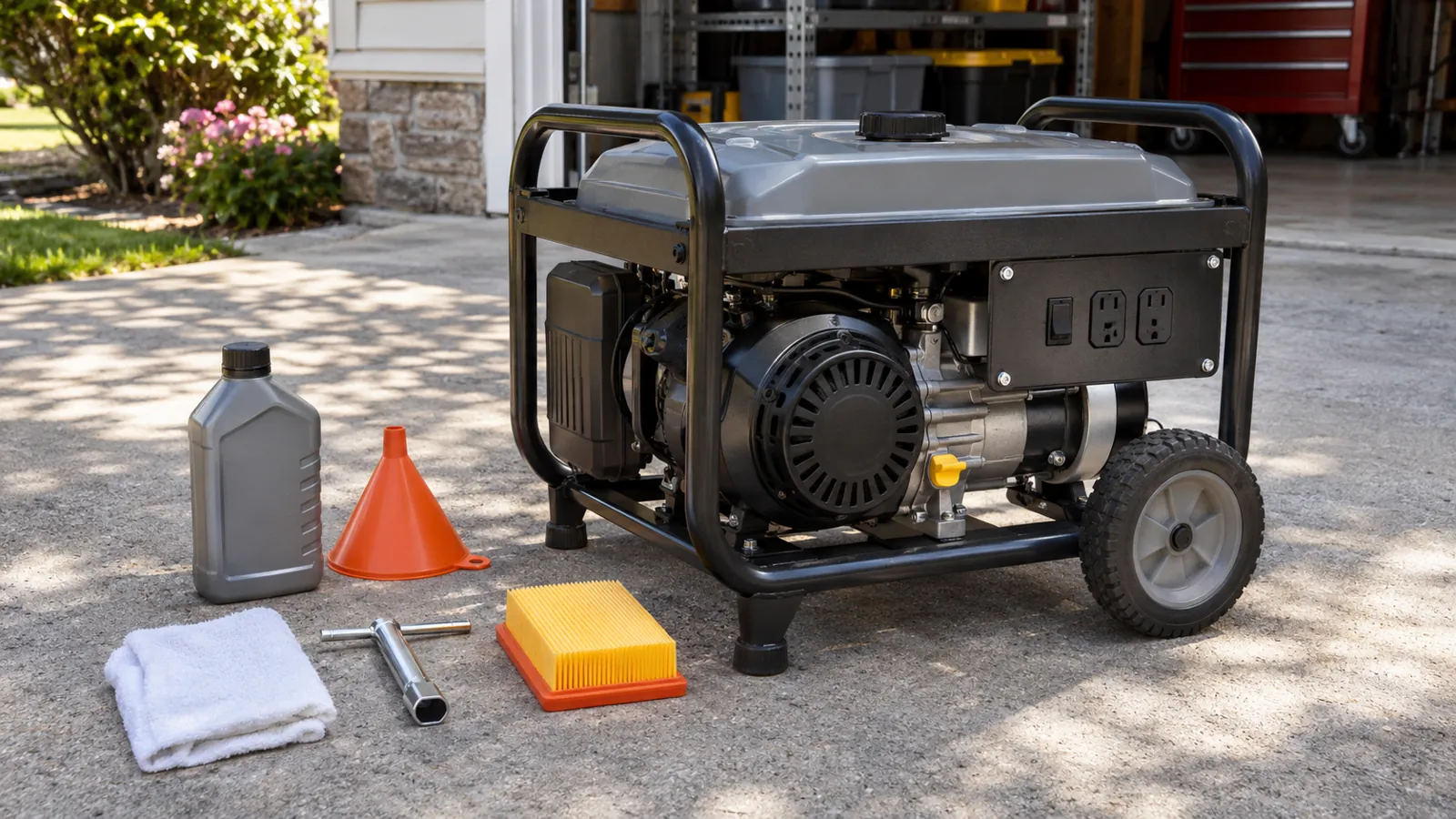
During a long outage, the hours add up fast: running 18 hours a day, a generator reaches a 50-hour oil change in under three days. Keep a few quarts of the right oil, a funnel and a spare spark plug with the generator.
Always change oil with the engine off and cooled, on level ground, outdoors.
Our picks for this guide
The highest-rated models in our comparison for this topic.
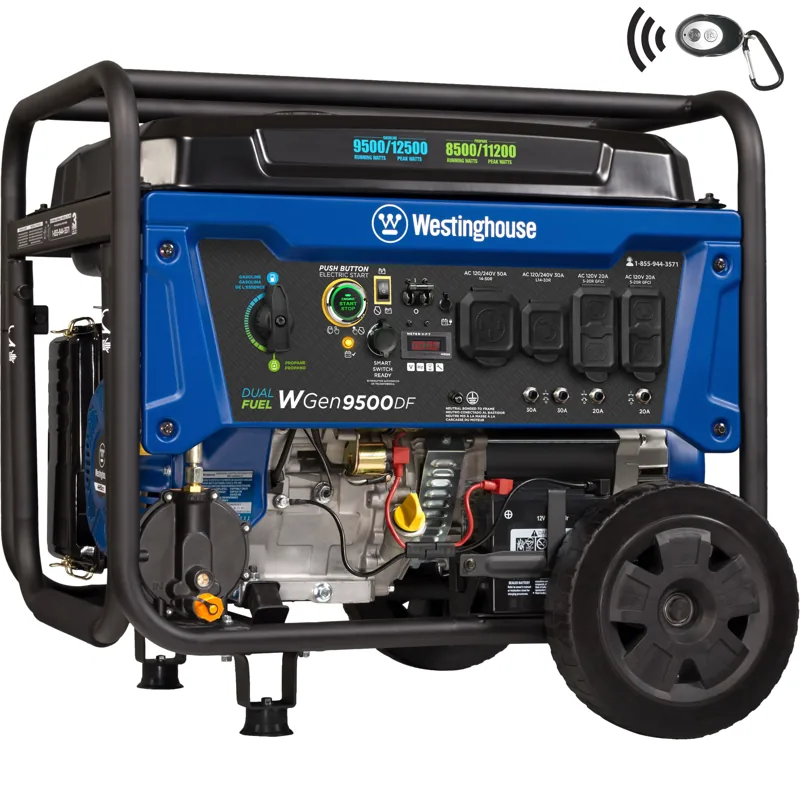 Westinghouse WGen9500DF
7.6/10 · $800–$1,200
9,500 running W · Dual fuel
Best value
Check price
Read the review →
As an Amazon Associate we earn from qualifying purchases, at no extra cost to you.
Fuel: the number one cause of no-start
Gasoline begins to degrade in about 30 days without treatment. Ethanol blends absorb water, and old fuel leaves varnish that clogs the small jets of the carburetor.
- Add fuel stabilizer to every can when you fill it, at the dose on the label, and run the engine a few minutes so treated fuel reaches the carburetor.
- Use E10 or ethanol-free gasoline; never E15 or higher in a generator.
- For storage longer than a month or two, either keep the tank full of stabilized fuel or run the carburetor dry: close the fuel valve and let the engine run until it stops. Many models also have a carburetor drain screw.
- Rotate your stored fuel every few months by pouring it into a car (if stabilized and fresh enough) and refilling with new fuel.
- On a dual fuel model, finishing on propane leaves the carburetor dry of gasoline. See gas vs. propane.
Exercise it monthly, under load
Start the generator once a month and run it for 20 to 30 minutes with a load of roughly a third to half of its rating, such as a space heater or a work light. Running under load warms the engine fully, burns off moisture, charges the starter battery and keeps seals lubricated. Running with no load at all does far less.
Exercise it outdoors, at least 20 feet from the house, exhaust pointed away, exactly as during an outage. See the safety guide.
Electric start battery
Generators with electric start or remote start use a small 12 V battery that self-discharges in storage. Keep it on a battery maintainer (smart trickle charger) or charge it every one to two months. Most models still have a recoil cord as a backup; make sure you can use it.
Long-term storage
- Store the generator in a cool, dry, ventilated place, such as a detached shed or a garage, never inside living space. Never run it there.
- Store it with stabilized fuel or a dry carburetor (see above), and with fresh oil, since used oil contains acids.
- Keep gasoline in approved cans away from the house and away from flames, pilot lights and electric motors.
- Cover the generator against dust once it is completely cool.
- Do not store it lying on its side; oil can migrate into the cylinder or air filter.
Pre-storm checklist
When a storm is forecast, run through this list a few days ahead:
- Start the generator and run it under load for 20 minutes.
- Check oil level; have spare oil, a spare spark plug and an air filter on hand.
- Fill approved cans with fresh, stabilized gasoline, or check your propane tanks.
- Charge the starter battery.
- Inspect extension cords and the generator cord for damage.
- Check that battery-powered CO alarms work inside the home.
- Choose the generator's spot: outdoors, at least 20 feet from the house, exhaust away from windows, doors and vents, ideally under a generator canopy designed for wet weather.
- If you have a transfer switch or interlock, review the switch-over steps; see the connection guide.
Fuel quantities for a multi-day outage are worked out in the runtime guide, and home backup models are in the home backup picks.
Our pick for this guide
- Best portable generator for home backup (68 models)
- Best generator with electric start (92 models)
- Best dual fuel generators (80 models)
Frequently asked questions
How often should I change the oil in a generator?
Change it after the first 5 to 25 hours of break-in, then typically every 50 to 100 hours or at least once a season. Your owner's manual gives the exact intervals for your engine.
Should I store my generator with gas in it?
Only if the fuel is treated with stabilizer, and even then for a limited time. For long storage, many owners run the carburetor dry or drain it to prevent varnish and clogged jets.
How often should I run my generator?
Run it about once a month for 20 to 30 minutes with a moderate load. It keeps the engine lubricated, the fuel moving and the starter battery charged.