
What size generator do you need for an RV?
The right RV generator depends on your shore power plug and on how many air conditioners you want to run. Start with the amps, then size for the roof AC starting surge.
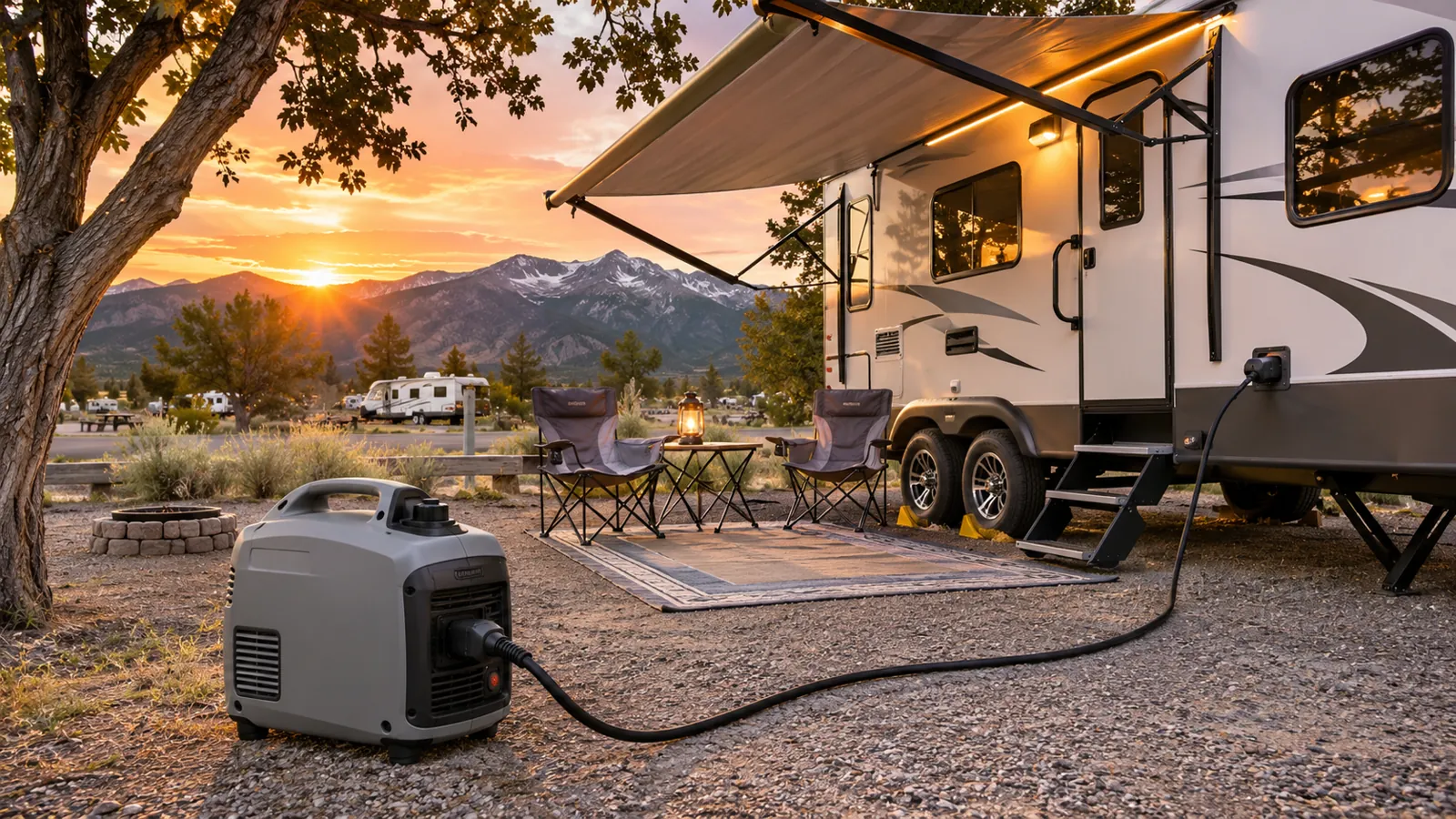
Step 1: check your RV's shore power
Look at the plug on your RV's power cord.
| RV service | Plug / outlet | Voltage | Maximum power |
|---|---|---|---|
| 30 amp | TT-30P / TT-30R | 120 V | 3,600 W |
| 50 amp | 14-50P / 14-50R | 120/240 V (two 50 A legs) | up to 12,000 W |
A 30 amp RV can never draw more than about 3,600 W, so a generator in the 3,000-4,500 W class with a TT-30R outlet covers it. Most 30 A rigs have one roof air conditioner.
A 50 amp RV has two separate 120 V legs, each able to carry 50 A (6,000 W), for a theoretical 12,000 W. In practice most 50 A rigs use 4,000-8,000 W at peak, with two roof ACs, a residential fridge and an electric water heater. A generator with a true 14-50R outlet that supplies both legs is required to use the full system; an adapter from a 30 A outlet to a 50 A cord works but only provides 30 A on one leg, enough to run one AC.
Step 2: size for the roof air conditioner
The roof AC is the biggest load in almost every RV, and its compressor start is the challenge:
| Roof AC | Running watts | Starting watts (no soft start) | With a soft start kit |
|---|---|---|---|
| 13,500 BTU | 1,200-1,600 W | 2,500-3,500 W | 1,500-2,200 W |
| 15,000 BTU | 1,500-2,000 W | 3,000-4,000 W | 1,800-2,600 W |
Add the rest of what runs at the same time: a fridge in electric mode (300-500 W), the converter charging the house batteries (up to 500-800 W), lights, a TV, fans. A microwave (1,000-1,500 W) or a coffee maker usually has to wait until the AC cycles off on a small generator.
Typical targets:
- 30 A RV, one 13,500 BTU AC: 3,000-3,800 running watts, or two 2,000-2,500 W inverters in parallel.
- 30 A RV, one 15,000 BTU AC: 3,500-4,500 running watts.
- 50 A RV, two ACs: 7,000-9,000 running watts with a 14-50R outlet, or a large inverter.
Our picks for this guide
The highest-rated models in our comparison for this topic.
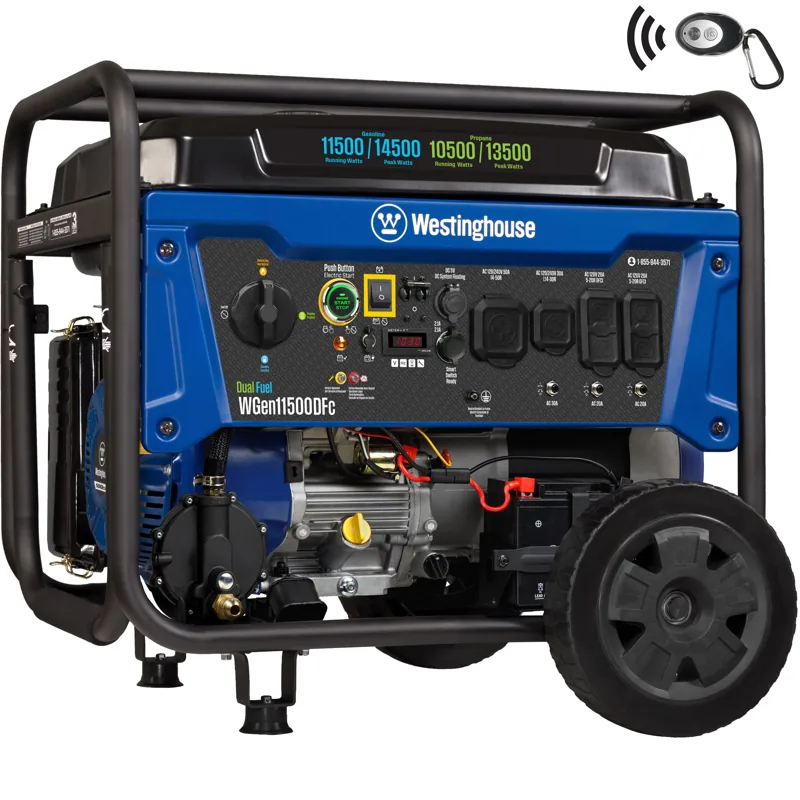 Westinghouse WGen11500DFc
8.3/10 · $1,200–$1,800
11,500 running W · Dual fuel
Top pick
Check price
Read the review →
As an Amazon Associate we earn from qualifying purchases, at no extra cost to you.
Soft start kits
A soft start kit is a small controller installed on the AC compressor that ramps up the motor instead of hitting it with full inrush current. It can cut the starting surge by more than half, often enough to run a 13,500 BTU AC on a single 2,200-2,500 W inverter at moderate temperatures. Installation involves opening the AC shroud and wiring; follow the kit instructions or ask an RV technician, and check that it does not void the AC warranty.
Parallel kits: two small generators instead of one big one
Two compatible inverter generators linked by a parallel kit add their outputs, and the kit usually provides a TT-30R outlet. Two units of about 1,800 running watts each give roughly 3,600 W, exactly a 30 A RV's limit, while each unit stays light enough (about 40-50 lb) for one person to lift. At night, run just one unit for the fridge and the battery charger. Details in the parallel guide and the parallel-capable picks.
Dual fuel and the RV propane tank
RVs already carry propane, so a dual fuel generator avoids hauling gas cans. Remember that most generators lose about 10% of output on propane; size for the propane rating. A qualified RV technician can add a proper propane quick-connect outlet on the RV system; do not improvise fittings. See gas vs. propane and the dual fuel inverter picks.
Noise and campground rules
Campgrounds care about noise more than about watts. National Parks cap generators at 60 dB(A) at 50 ft and restrict generator hours; many campgrounds enforce quiet hours, often from 10 p.m. to 6 or 7 a.m. Inverters at 48-60 dB(A) at 23 ft fit these rules; most open frames at 68-76 dB(A) do not. The decibels guide explains the numbers.
Safety at the campsite
- Never run a generator inside the RV, in a pass-through compartment, or under the slide-outs or awning. Built-in RV generators are designed and vented for their compartment; portables are not.
- Keep the generator as far from your RV and your neighbors as practical, exhaust pointed away from doors, windows and vents.
- Keep a working CO alarm inside the RV and test it before each trip.
- Use an RV surge protector between the generator and the RV cord.
- Refuel only when the engine is cool.
Full rules in the safety guide.
Quick answer
| RV | Good fit |
|---|---|
| Small trailer or van, no AC | 2,000 W inverter |
| 30 A, one 13,500 BTU AC | 3,000-4,000 W inverter, or two 2,000 W inverters in parallel |
| 30 A, one 15,000 BTU AC | 3,500-4,500 W inverter, or a soft start kit |
| 50 A, two ACs | 7,000 W and up with a 14-50R outlet |
Browse the RV picks or the 3,500 W class.
Our pick for this guide
- Best generator for RV (84 models)
- Best parallel capable inverter generator (98 models)
- Best 3500 watt generator (32 models)
- Best dual fuel inverter generators (46 models)
Frequently asked questions
What size generator do I need for a 30 amp RV?
A 30 amp RV can draw up to 3,600 W, so a generator with 3,000 to 4,500 running watts and a TT-30R outlet covers it. Two 2,000 to 2,500 W inverters in parallel are a popular alternative.
Will a 2,000 watt generator run an RV air conditioner?
Usually not on its own, because a 13,500 BTU roof AC needs 2,500 to 3,500 W to start. With a soft start kit installed on the AC, many 2,200 to 2,500 W inverters can start and run it in moderate weather.
Can I plug a 50 amp RV into a 30 amp generator?
Yes, with a 30 A to 50 A adapter, but you only get 30 A on one leg, about 3,600 W. That is enough for one air conditioner and basic loads, not for the full 50 A system.